Classic indicators don't time entries
Know When Not to Enter · Lesson 4/29
The problem: the reading was right and the entry was wrong
My bot Lazarus traded a Z-score rule, a close relative of Bollinger Bands. When price stretched far from its average, the bot entered against the stretch and waited for the return. In a 72-hour audit it made 52 trades, won 46.15 % of them and ended at -24.79 USDT [1].
Equinox had the same weakness in another form. Its mean-reversion rules fired too early in strong trends, and the bot entered while price was still falling.
Plutos used a technical score with a fixed threshold band. In a small sample of 36 trades, the filter failed when the trend shifted. In each case the indicator said something true about price. The entry still came at a bad moment.
Why it happens: an indicator describes a state
Classic indicators are arithmetic on past prices. RSI, MACD, moving averages and bands all summarise what price has done. They describe a state: oversold, trending, stretched.
A state can last. A coin that is oversold can stay oversold through another 3 % drop. The indicator was correct the whole time, and the entry lost anyway.
There is a second issue. Most indicators come with fixed levels, such as RSI 30 and RSI 70. The same level means different things on a calm large coin and on a volatile small one. It also means different things in a quiet week and in a violent week.
What large tests found
The third issue is that these rules are public and have been tested at scale. Aronson tested 6,402 technical rules on the S&P 500 index. After correcting for data-mining bias, none showed a statistically significant result [2].
Sullivan, Timmermann and White tested 7,846 rules on 100 years of the Dow Jones index. The best rule looked strong in the first 90 years. Its advantage did not repeat in the ten years that followed [3].
These studies looked at stock indices, not at crypto futures. I do not claim that they settle the question for every market. They did change how much proof I ask for before I trust a rule.
This does not make indicators useless. They are a fair description of direction and state. They were never built to answer a different question: is this minute a bad one to enter?
What helps: four habits
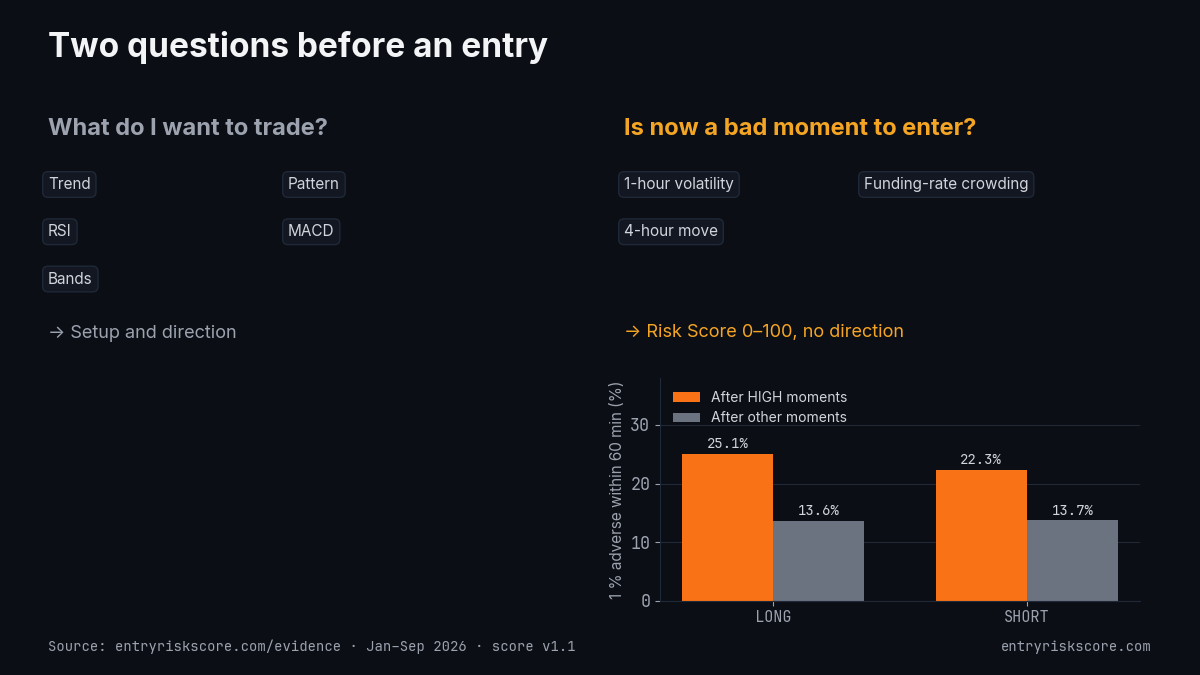
- Keep two questions apart. What do I want to trade, and is now a bad moment to enter? Use different inputs for each.
- Read an indicator against the coin's own history. A fixed level ignores how that coin usually behaves.
- Add an input that is not built from the same price series. The funding rate is one example. It reflects positioning.
- Test on data that was never used for tuning. A rule tuned and tested on the same months proves little.
I still use indicators. They compress a chart into a few numbers, and they are a clear way to define a setup. My mistake was to ask them for something else. I expected a tool that describes direction to also tell me when to act.
What the data shows: the moment matters on both sides
Entry Risk Score does not look at direction. It is computed the same way whether a setup says long or short. If the moment carried no information, HIGH moments and other moments would show about the same rate of adverse moves. In the nine-month check they did not [4].
| Entry held 60 minutes, adverse move 1 % | After HIGH moments | After other moments | Months HIGH was higher |
|---|---|---|---|
| LONG | 25.1 % | 13.6 % | 9 of 9 |
| SHORT | 22.3 % | 13.7 % | 9 of 9 |
These are past frequencies from January to September 2026, across 19 coins. They are not odds for a future trade.
What did not work
Before the score was fixed, I measured seven other candidate inputs as well. They were the bid-ask spread, the top-trader long/short ratio, taker flow and the age of the move. The list also included shorter extensions, the volume ratio and the 1-hour change in open interest.
None of the seven separated adverse outcomes, and I dropped them [5]. Most of my ideas failed this test. Three inputs remained.
How Entry Risk Score fits in
Entry Risk Score takes the second question and nothing else. Every 5 minutes it ranks the current moment against the coin's own last 90 days, using 1-hour volatility, funding-rate crowding and the 4-hour move in the trade direction. HIGH means the score is 80 or above.
Your indicators can still decide what you want to trade. The score is one more input, read before the order. It never gives direction, and it never tells you to open or close a position.
HIGH is no verdict either. In the nine-month check, about three out of four HIGH moments on the 60-minute LONG profile were not followed by the adverse move. The score marks moments that deserve a second look.
Further reading
- The numbers behind the table, month by month: 1.5 million moments: what nine months say about entry timing
- The inputs that were kept and the ones that were dropped: entryriskscore.com/methodology
- Aronson, Evidence-Based Technical Analysis, on testing rules with statistical care [2]
- Next lesson: chasing the move, and the 4-hour run-up
Entry Risk Score is a data service. It is not investment advice and makes no promise of returns.
References
[1] Author's post-mortem audit files for the Lazarus, Equinox and Plutos bots, April to June 2026. Unpublished trade logs, amounts quoted as recorded.
[2] Aronson, D. R. (2006). Evidence-Based Technical Analysis. Wiley.
[3] Sullivan, R., Timmermann, A., and White, H. (1999). Data-Snooping, Technical Trading Rule Performance, and the Bootstrap. The Journal of Finance, 54(5), 1647-1691.
[4] Entry Risk Score. Evidence: HIGH moments vs all other moments, January to September 2026, score v1.1. https://entryriskscore.com/evidence
[5] Entry Risk Score. Methodology, score v1.1. https://entryriskscore.com/methodology
References
- Author's post-mortem audit files for the Lazarus, Equinox and Plutos bots, April to June 2026. Unpublished trade logs, amounts quoted as recorded. ↩
- Aronson, D. R. (2006). Evidence-Based Technical Analysis. Wiley. ↩
- Sullivan, R., Timmermann, A., and White, H. (1999). Data-Snooping, Technical Trading Rule Performance, and the Bootstrap. The Journal of Finance, 54(5), 1647-1691. ↩
- Entry Risk Score. Evidence: HIGH moments vs all other moments, January to September 2026, score v1.1. https://entryriskscore.com/evidence ↩
- Entry Risk Score. Methodology, score v1.1. https://entryriskscore.com/methodology ↩
More in Entry timing
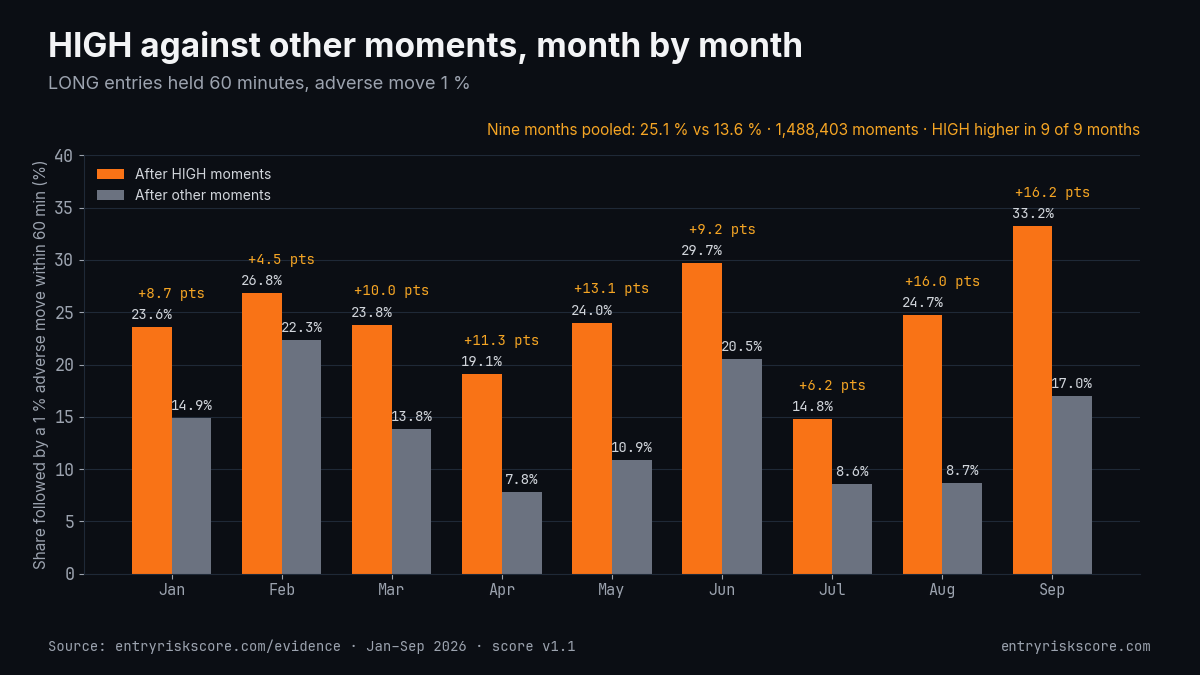
1.5 million moments: what nine months say about entry timing
I froze the rules and recomputed nine months of Binance futures data. Here is what HIGH moments were followed by, in plain words, weak months included.